This article has been translated from the original Japanese using DeepL. Please note that some nuances or technical terms regarding local history may differ from the original.
For the original Japanese version : Click here
For a more immersive experience: If you’d like to explore this history through a story, please read the [Novel version on note (Click here)].
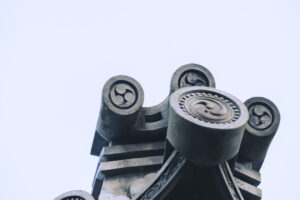
Shinto shrines each have a “shrine crest” that symbolizes their history and beliefs.
Just like family crests, these are cherished symbols that have been passed down over generations.
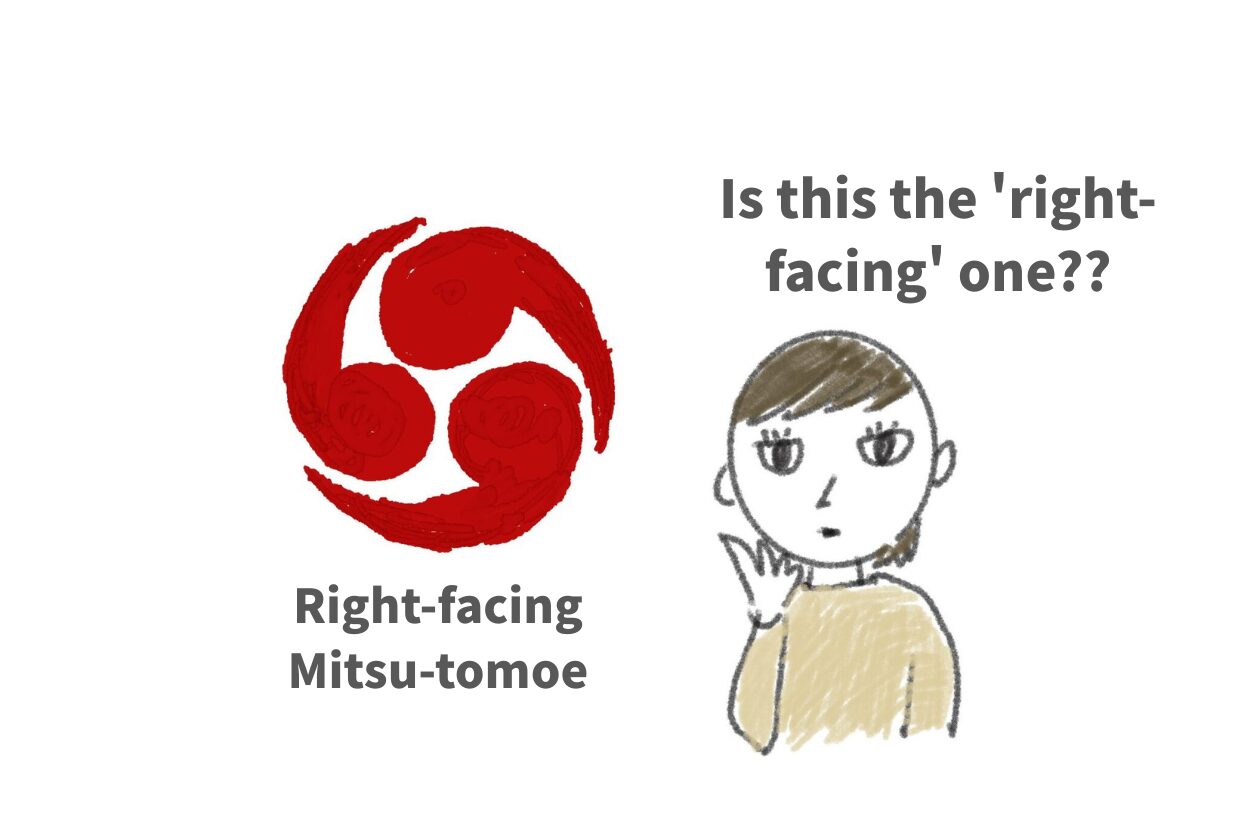
Recently, while searching for shrines on Google Maps, I happened to come across a shrine that uses the “right-facing triple tomoe crest.”
I had always taken the Tomoe crest for granted, but at that moment, I became acutely aware of the difference in orientation between the “right” and “left” versions.
In this article, using the distinction between the right-facing and left-facing Tomoe crests as a clue,
I would like to summarize the small mysteries and insights that emerged as I traced the actual shrines, their locations, and the deities they enshrine.
Did you notice the orientation of the “Tomoe” crest?
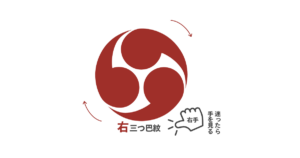
The Tomoe pattern is characterized by its distinctive design featuring three magatama-shaped motifs arranged in a circular rotation.
In fact, there are different “orientations” within this Tomoe pattern.
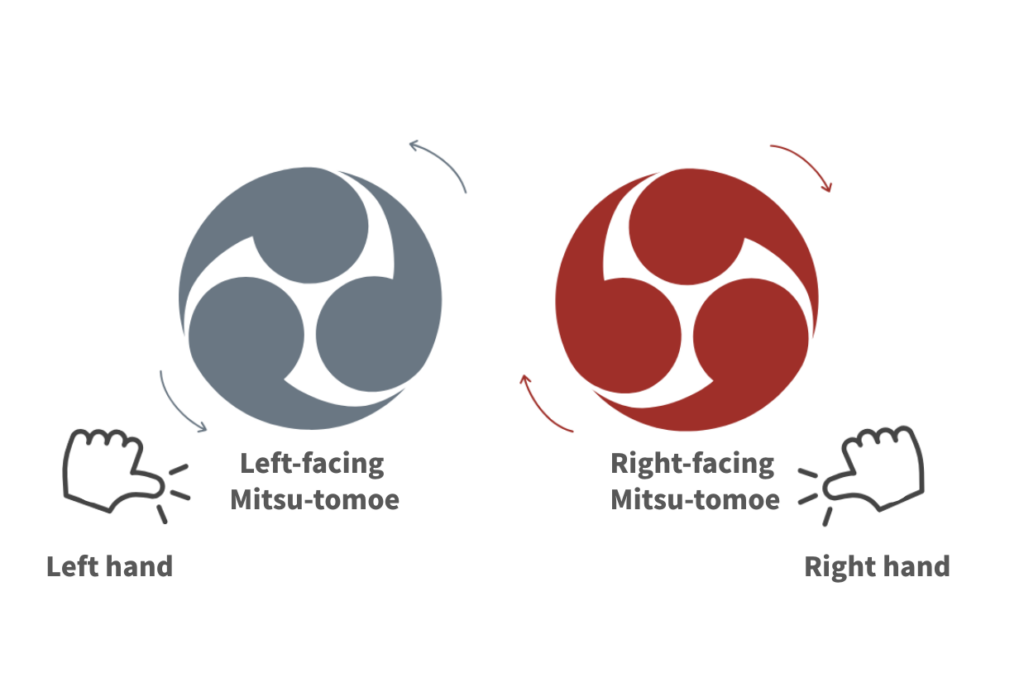
- The one with the tails curving clockwise is the “Right Totsubara Crest.”
- The one with the tails curving counterclockwise is the “Left Totsubara Crest.”
There are various theories regarding the origin of the symbol’s shape—including the magatama, lightning, snakes, clouds, human souls, the sun, and the moon—but no definitive consensus exists.
However, as explained in detail in the article below, there appears to be a theory that clockwise (right) rotation signifies positive growth, while counterclockwise (left) rotation signifies negative suppression.
The emblem of Usa Jingu, the head shrine of the Hachiman shrines, is the “left-facing triple tomoe.”
For this reason, the left-facing triple tomoe is commonly found at Hachiman-affiliated shrines, and many people likely associate the tomoe crest with a left-facing orientation.
I, too, had been under that impression until very recently.
In the writings of Motoji Niwa (*), a scholar known for his research on divine and family crests, the correct method of identification is said to be determining whether the crest is right-facing or left-facing based on the direction in which the “tadpole’s head” is turned.
However, as time passed, people began to distinguish between them based on the “direction of the tail” or “visual impression,” and it seems there are many cases where names opposite to the original definition have become widespread.
In this “Toyono-kuniaato,” we use the “Left Triple Tomoe Crest” officially transmitted by Usa Jingu as our standard, and we refer to the opposite orientation as the “Right Triple Tomoe Crest” in accordance with the commonly used terminology.
This article will proceed based on these notation rules.
(*) Mr. Niwa’s research on divine crests covers famous shrines nationwide, excluding former village shrines and small shrines of unranked status or lower.
Discovering the “Right-Facing Triple Tomoe Crest”: The Case of Imizaki Shrine on the Kunisaki Peninsula
What first drew my attention to the right-facing triple-leaf crest was
when I was looking at Imizaki Shrine on Google Maps—a shrine situated along the coast in the northern part of the Kunisaki Peninsula.
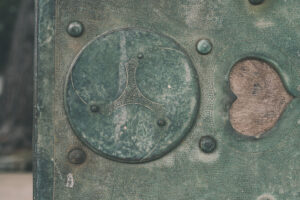
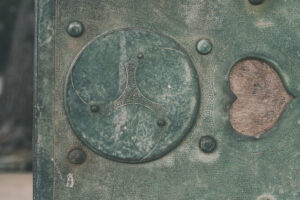
The faint crest remaining on the offering box was a triple-leaf crest.
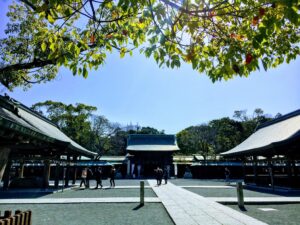
Given the vermilion-colored shrine building, I initially thought it might be associated with the Hachiman lineage linked to Usa Jingu, but upon further research, I discovered that the enshrined deity was entirely different.
Deities enshrined: Izanagi-no-Mikoto, Izanami-no-Mikoto, and Kikuri-hime-no-Mikoto
(Source: Mura no Chinju no Dotcom)
The principal deities of Usa Jingu—
Hachiman-no-Ōkami (Emperor Ōjin)
Hime-no-Ōkami
Empress Jingū
—belong to a different lineage.
Among them, the figure of Kukurihime particularly caught my attention.
Kukuri-hime is known as the principal deity of Hakusan-hime Shrine in Ishikawa Prefecture, the center of Hakusan worship, and is a unique goddess who appears only in the “Alternative Account” section of the *Nihon Shoki*.
As the being who intervened between Izanagi and Izanami in the Land of Yomi and exchanged words with them, she is sometimes described as a goddess of matchmaking, harmony, and the bridge between life and death.
A goddess of the Hakusan lineage enshrined along the coast of the Kunisaki Peninsula?
And upon closer inspection, I noticed that the orientation of the tomoe crest was the opposite of that at Usa Jingu.
Although I couldn’t find any significant information when I looked into the right-facing triple tomoe crest, I couldn’t help but investigate, thinking, “There might be something to this.”
Tracing the Meaning of the Place Name “Imi”
The place name “Imi,” where the Imizaki Shrine is located, also has a very ancient origin.
According to the book *Walking Through the Place Names of the Kitaura Region on the Kunisaki Peninsula* (by Kyushu Hirosue), as mentioned by a writer for the blog “A Blog for Finding Joy in Everyday Life,” the name is believed to derive from “imichi” or “saichi”—special places where deities were enshrined.
“To purify one’s body and mind, and to abstain from impurity”
“A place where rituals for the gods are conducted”
The word “imi” originated from these meanings
and has been preserved as a place name denoting a site of ritual.
The Kunisaki Peninsula is a place where the Shugendō culture of the Rokugo Mansan region flourished, and it has also been a key hub for transportation and religious pilgrimage since ancient times.
At Cape Imi, there stands a shrine dedicated to Izanagi, Izanami, and Kikuri-hime, and its emblem is not the one associated with the Hakusan lineage, but rather the “triple tomoe.”
Furthermore, a right-facing triple tomoe—the opposite of the one used in the Usa lineage—has been chosen.
I could not help but feel that this combination was no coincidence.
Why was the triple-clover crest chosen?
“Why Is There a Difference Between Right and Left?”
Even when I asked historians, I couldn’t get a clear answer about the distinction between right and left.
“Well, I’ve never really thought about it,” or “Maybe it’s just a mistake?”—even when they said things like that,
I couldn’t help but wonder if there might be some deeper meaning behind:
Imi, a place of great ritual significance;
the deities enshrined in the Hakusan mountain range;
and the choice of the “right-facing triple tomoe”—the opposite orientation from that of Usa Jingu.
It took me longer than I expected to arrive at a hypothesis.